

A dummies guide to finding an office
The Elizabeth Line Has Done More Than Improve Journey Times Across London.
The Elizabeth Line has done more than improve journey times across London. It has reshaped how occupiers, landlords, and investors think about office location, labour access, and long-term value. In a market where every office decision is under greater scrutiny, transport connectivity has become an even more important part of the equation.
For many businesses, the line has widened the map.
Connectivity Has Increased Location Choice
Since opening in May 2022, the Elizabeth Line has materially improved links between Heathrow, the West End, the City, Canary Wharf and key commuter locations to the east and west of London. Transport for London has reported strong passenger growth, with the line becoming one of the capital’s most significant transport assets in a relatively short period of time. This matters because improved connectivity directly affects recruitment reach, commuting convenience, and office attendance patterns.
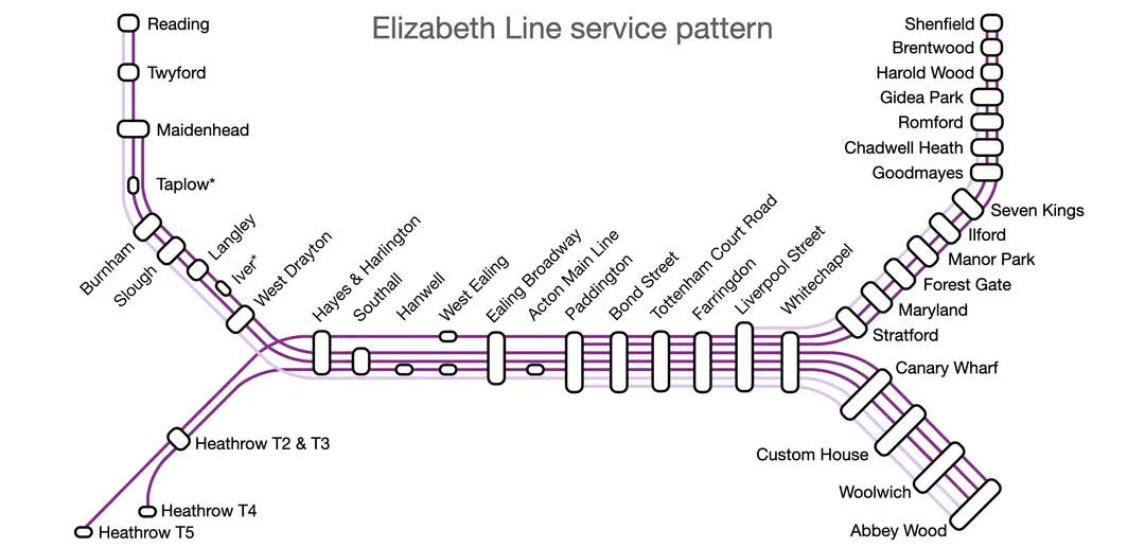
In practice, we have seen this strengthen the appeal of office locations around stations such as Paddington, Farringdon, Liverpool Street, Canary Wharf and Whitechapel. Areas once seen as secondary by some occupiers are now part of a far more connected core.
Elizabeth Line service pattern
The Line Has Supported Rental and Demand Resilience
The impact has not been uniform, but better connected locations have generally gained stronger occupational relevance. Knight Frank noted that rents around Elizabeth Line locations have risen, while wider London office commentary from CBRE points to resilient take-up and continued tenant focus on well-located space. In 2025, Central London take-up reached 11.4 million sq ft, broadly in line with long-term trends, with demand increasingly shaped by quality and accessibility.
This is an important point. The Elizabeth Line has not removed wider market pressures such as hybrid working, fit-out costs, or the flight to quality. What it has done is improve the competitive position of buildings that combine strong connectivity with modern specification.
What Occupiers Should Take From This
For office occupiers, the lesson is strategic rather than purely geographic.
Key considerations now include:
- Whether improved rail access allows a wider catchment for talent
- Whether a location outside the traditional core can now deliver comparable convenience
- Whether staff attendance improves when commuting friction is reduced
- Whether better connected buildings offer stronger long-term value, even at a higher headline rent
A cheaper office in a poorly connected location can quickly become more expensive if it weakens utilisation, recruitment, or retention.
Final Thoughts
The Elizabeth Line has not changed every part of the London office market equally, but it has shifted the balance in favour of connected, accessible and future-ready locations. For occupiers and investors alike, transport infrastructure is no longer a background factor. It is central to workplace strategy.
Get in touch if you’d like to discuss your future workplace plans and how connectivity should shape your office search.

Can we help you?